Tuesday, January 21, 2014

Sea Grant Up-Date

This morning I met with Kelly Spratt (Sea Grant's primary contact in St. Marys), Councilman Bob Nutter, and Planning Director, Roger Weaver. I am stunned and gratified by the magnitude of work that's been accomplished thus far.
 
The preliminary site visit by the FEMA representative indicates that we are well-positioned (with do-able work) to attain a favourable Community Rating System score and this should prove invaluable in terms of off-setting the rising flood insurance rates caused by the misguided Biggert-Waters Act.
 
At this time the Sea Grant team is working closely with city staff (primarily Mr. Weaver) to compile the information necessary for full examination and analysis of our status. This stage will be followed by interviews (which are being arranged) and the formulation of VCAPS (Vulnerability Consequences Adaptation Planning Scenarios). Throughout the two-year process there will be a series of public meetings - the first of which is tentatively scheduled for mid-March and will be well-publicized. 
 
I will endeavour to update everyone regularly via emails, the media, the EarthKeepers' website and our Facebook page. At this time there's little that concerned citizens can do other than attend the announced meetings and applaud Council for their clear-eyed decision to embrace this initiative. Sea Grant is deep in the realm of complex mapping and a level of science that, quite honestly, keeps me scrambling up the learning curve.
 
I am deeply pleased by our community's support for this project, and the fact that St. Marys now stands as one of the most proactive and progressive coastal cities on either seaboard. The work that we do here will serve as a blueprint for communities throughout America - and beyond.
 
Biggert-Waters may be "delayed" but, according to the Government Accountability Office, the National Flood Insurance Program (NFIP) is approximately $24 billion in debt to the Treasury. The premiums are too small to cover its costs, pay claims to flooded homeowners, and repay the Treasury.  Property-owners will, sooner or later, be forced to cover the costs. http://www.moneynews.com/Personal-Finance/spending-bill-flood-insurance/2014/01/15/id/547309
 
What strikes me in all of this is our acceptance that we can't (won't) strive to lower the river, and so we must try to raise the "land." We are, on a national and global basis, becoming reactive instead of proactive when it come to climate change and its cataclysmic impacts. As I have said before, I urge you all to contact your elected officials. Ask them about their stance on climate change...and then cast your votes accordingly.

Alex


Monday, January 6, 2014

2014!

Happiest New Year to all! 

2013 was an exciting year in St. Marys as we continued to increase our recycling rate, inform and energize our community, and address the many challenges posed by climate-change and sea level rise.

So a new year stretches ahead…

With the NOAA Sea Grant – a powerful tool in our tool-box – we begin the work of ensuring that our extraordinary coastal community will be prepared for climate-related events and to deal with the crushing flood insurance rates that may come about as a result of the ill-advised Biggert-Waters Flood Insurance Act. http://www.fema.gov/flood-insurance-reform-act-2012http://www.fema.gov/flood-insurance-reform-act-2012

We can reduce otherwise-unaffordable insurance rates by scoring well on the Community Rating System (http://www.fema.gov/national-flood-insurance-program-community-rating-system) and I am pleased to say that our city administration is fully behind this effort.  
The work has begun: the Sea Grant teams are active in St. Marys, information is being compiled and recommendations amassed. The work that we do here will not only benefit the citizens of our town, but will serve as a blueprint for all coastal communities.  Congratulations, St. Marys.

Meanwhile, the EarthKeepers continue to promote conscientious environmental stewardship, hold Electronics-recycling events, stand guard over our river and lands, support the many “green” groups in our schools, provide information to the residents, and do what we can honor the fact that “We will be known forever by the tracks we leave.”

Alex


Sunday, November 17, 2013

The Sea Grant Project Begins...

This was the Agenda for the St. Marys Technical/Familiarity Visit Regarding Sea Grant on November 14, 2013:

1. 10:00 – 10:10 am - Welcome by Mayor-elect Morrissey
2. 10:10 am - Commence Visit with Project overview from Sea Grant principals: 


Dr. Jessica Whitehead (Coastal Communities Hazards Specialist, NC Sea Grant)
David Bryant (Assistant Director, GA Sea Grant)
Dr. Chuck Hopkinson (Director, GA Sea Grant)
Kelly Spratt (Local Government Outreach Coordinator, GA Sea Grant)
Jill Gambill (Public Relations Coordinator, GA Sea Grant). 
Dr. Jack Thigpen (Extension Director, NC Sea Grant)
Dr. Jason Evans (Environmental Sustainability Analyst, Carl Vinson Institute of Government)

a. Chuck Hopkinson 
i. Brief summary of Community Climate Adaptation Initiative program, and recap of how this project took shape


b. Have everybody go around and say what most concerns them about flooding/coastal hazards risks to St. Marys 

c. Kelly Spratt 
i. Discussion of flood insurance, Biggert-Waters Act, & CRS (Community Rating System)


d. Jess Whitehead and Jason Evans
i. Overview of project facilitation/technical strategy & timeline 

e. Open discussion
i. Questions & issues of concern
ii. Maps and pictures
iii. Local policy linkages
iv. Outreach discussions
v. Contacts for infrastructure/GIS data 

f. Discussion on physical needs for the Grant (space, IT, furnishings, etc.)

g. Tour of St. Marys

h. 7:00 pm - Reception hosted by the St. Marys EarthKeepers

Our thanks to City Council, City Manager, Steve Crowell, Planning Director, Roger Weaver, and the St. Marys EarthKeepers' board for helping to make the launch of the Sea Grant project a resounding success. The meeting was highly-informative with (despite the short notice) 45 in attendance (city officials and members of the public). It was followed by a full day of discussions and golf cart/van tours of St. Marys. The evening reception was thoroughly enjoyable, with 80+ civic leaders/general public able to speak with the GA and NC personnel.

Throughout the entire time, the Sea Grant teams continually expressed their "amazement" over the "unprecedented" level of professionalism, involvement and hospitality of our community. We are setting a very high standard for all other Sea Grant partners - plus leading the way in ground-breaking research while gaining a national/international reputation for proactive planning and progressive policy.


Thursday, November 7, 2013

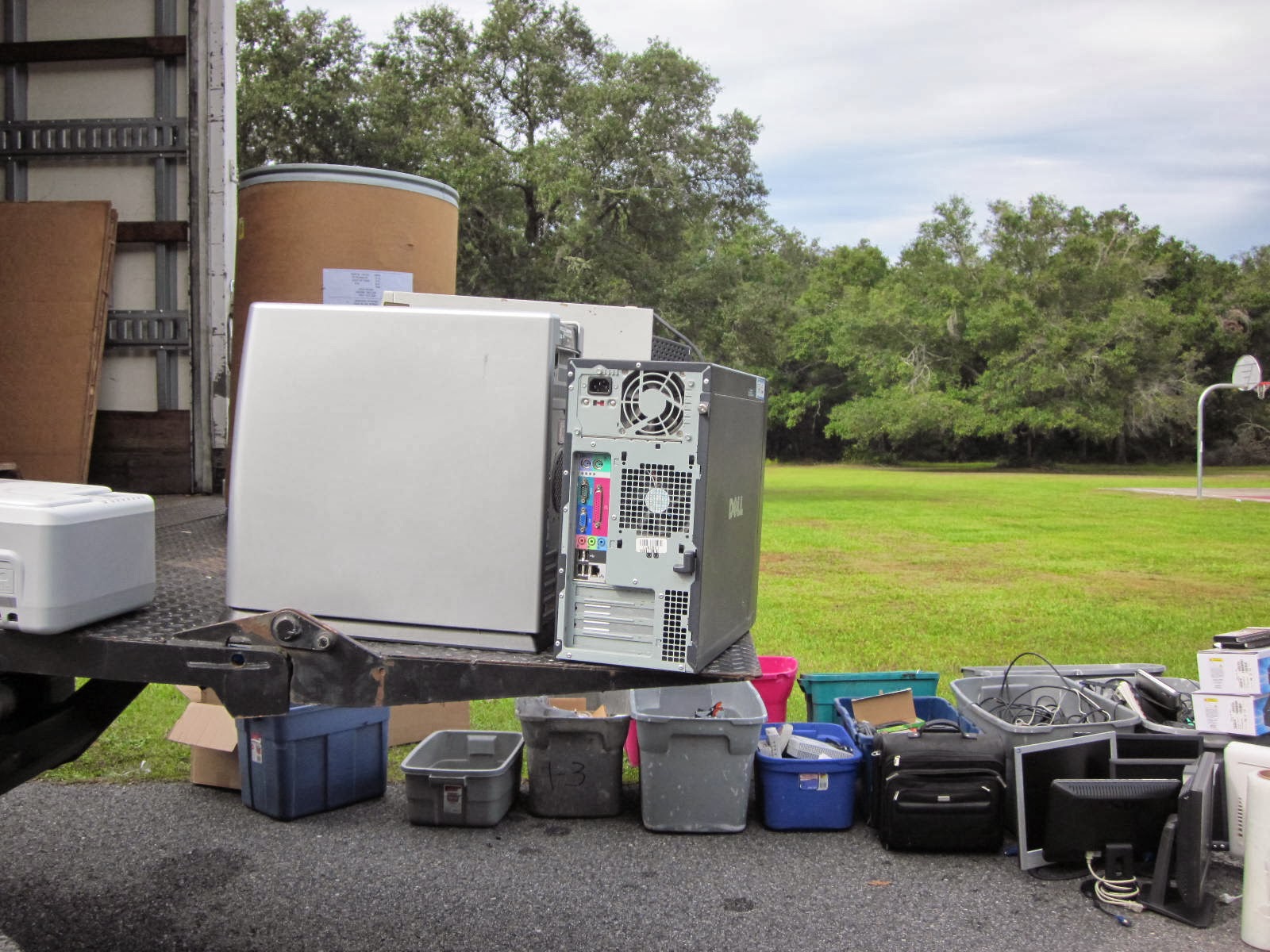
Our latest Electronics-Recycling/Paper Shredding Event on Nov. 2 was another resounding success. It's always so amazing to watch the amount of "stuff" that comes in...and Camden County is just one small map-dot on the planet. "Due to popular demand", we'll continue holding these events twice per year. Our thanks to the many people who hold on to their e-scrap and paper-work until it can all be fully recycled!


Next week we welcome Georgia Sea Grant and North Carolina Sea Grant teams to St. Marys. http://georgiaseagrant.uga.edu/article/9_25_13_st_marys/
 

The plans for the reception on the 14th are set, the invitations have been sent out and all is in readiness to start this exciting project. 


Monday, October 21, 2013

E-Scrap and Paper-Shredding Event, Nov. 2!

Out With The Old!

Christmas will be here before you know it. Don’t start the New Year with your house and shed full of old electronics and paper files!
Due to popular demand, the St. Marys EarthKeepers are hosting another E-Scrap Fair.

When: Saturday, November 2, from 10 am to 4 pm.

Where: St. Marys Aquatic Park (Herb Bauer Dr.)

What: All electronics. If it has a plug we accept it – with the exception of old tube televisions. And bring along anything that requires batteries, even the old batteries themselves.

With Sentry Data Management’s secure paper shredding, you can toss it all in without worrying about staples, paper clips etc.

Please note: We will not be collecting paint and household hazardous materials.

A suggested $5 donation to the St. Marys EarthKeepers would be greatly appreciated.


Saturday, August 31, 2013

We Won The Grant!

Sea Grant and UGA Help Communities Plan for Sea Level Rise

Georgia Sea Grant, North Carolina Sea Grant and the University of Georgia are launching a project to help St. Marys, Ga. and Hyde County, N.C. plan for sea level rise, increased coastal flooding and intensified storm surges.

Funded by the National Oceanic and Atmospheric Administration, the project is part of the National Sea Grant College Program’s nationwide effort to assist communities in preparing for the current and predicted impacts of climate variability and change.

St. Marys, Ga. is one of the most vulnerable cites in Georgia to these impacts. “90 percent of the historic structures in our historic district have their lowest floor elevation located below the current 100-year flood elevation,” said St. Marys Mayor William DeLoughy. “This study will hopefully provide the City—and other historic coastal cities—with guidance in how best to accommodate sea level rise for historic districts and structures.”

Established in 1787, St. Marys is home to valuable historical assets that city officials are keen to protect. The St. Marys Earthkeepers organized a public seminar earlier this year on sea level rise that brought in key city officials and over 120 residents from the community.

As part of the project, Georgia Sea Grant, the Carl Vinson Institute of Government and Marine Extension Service, all Public Service and Outreach units within the University of Georgia, will conduct research and collect information to analyze the costs and benefits for a range of actions designed to reduce vulnerability to climate impacts. This partnership is expanding upon a similar sea level rise adaptation project on Tybee Island, Ga. that received Georgia Trend Magazine’s “Four for the Future Award.”

“Much of Georgia’s shoreline lies just a few feet above sea level,” said Jason Evans, environmental sustainability analyst with the UGA Carl Vinson Institute of Government. “When you combine this with the substantial growth expected in coastal Georgia over the next few decades, you have increasing numbers of people, property, infrastructure and natural systems along the Southeast Atlantic coast likely becoming vulnerable to climate-related risks.”

The project also will address similar climate-related vulnerabilities in Hyde County, N.C. In both locations, the Georgia team will provide expertise in comparing the costs and benefits of adaptation actions, while N.C. Sea Grant will take the lead in developing, through a series of public workshops, detailed assessments of communities’ current and future vulnerabilities. The end result will be resilience and adaptation plans tailored to the needs of each community.

The team intends to link proposed adaption actions with the Federal Emergency Management Agency’s Community Rating System program, potentially reducing flood insurance rates for local residents as the plans are implemented. Lessons learned in these communities will be shared with other communities in the Southeast and through the National Sea Grant network.


We're doing well...but we can do even better!


Friday, June 21, 2013

EarthKeepers on Facebook

For day-to-day news and discussions, you can find us on Facebook at https://www.facebook.com/groups/44706969520/?fref=ts

Adopt-A-Nest!

With thanks to the Tribune & Georgian for this article:

"With another round of 5-percent federal cuts slated for October, Cumberland Island National Seashore staff are looking to the future of the park’s sea turtle monitoring program.
“It’s 18 miles of undeveloped beach,” island wildlife biologist Doug Hoffman said. “We typically account for 25 to 30 percent of the statewide nesting total. It’s arguably the most important nesting beach in Georgia.”

Typically, the island receives two to four interns through Student Conservation Corps who patrol the beach daily between May and October noting false crawls, marking new nests, taking egg samples for a genetics study, moving nests laid too close to the water farther toward the dunes, documenting hatchings that start about late July and later excavating the nests to see how many turtles emerged.

“We have been monitoring the sea turtles on Cumberland since the 1970s,” Hoffman said. The program costs $18,000 annually, Hoffman said, and could be cut come October. “Our division does not have a lot of extra money except for salaries and the sea turtle program,” Hoffman said, noting the department had two employees leave and one retired, which resulted in some savings.

One source of funding for next year is Seaturtle.org’s adopt-a-nest program. The adoption fee is $25, with $10 going to the nonprofit website and $15 to the beach, Hoffman said. People can adopt a nest this season — Cumberland already has 203 — and the money would be held to fund the program in 2014. “There’s just not a big pot of money somewhere that we can draw from,” Hoffman said of financing the program. Each adoption includes a certificate, customized adoption webpage, the adopter’s name on the nesting beach’s webpage and updates on the nest throughout the season.
“Adopting a sea turtle nest is a great way to assist the National Park Service on Cumberland Island to conserve this fragile species,” seashore superintendent Fred Boyles said. “Adopting a nest makes a great gift or a way to help teach kids about stewardship of our ocean resources."

(I just adopted nest 66166
Nest Activity:

Nest was laid on 31 May 2013 by a Loggerhead sea turtle. The nest was protected with a plastic screen.
31 May 2013 - Nest was relocated (154 eggs).
31 May 2013 - 4 Eggs lost because of Ghost Crab).

http://www.seaturtle.org/nestdb/adopt/index.shtml?b=90&referer=http%3A%2F%2Fwww.seaturtle.org%2F

St. Marys Binational Peace Garden


Our sincere thanks to Pastor Rick Douylliez and the First Presbyterian Youth Group for their wonderful work at the St. Marys Binational Peace Garden! They weeded, mulched, cleaned and made the Garden shine. 

Tuesday, April 16, 2013

Georgia Sea Grant


April 15th, 2013:
 
St. Marys' City Council has chosen (unanimously) to forge ahead with the St. Marys/Georgia Sea Grant partnership. This coming Friday the grant proposal will be submitted (we are in competition with 32 other cities). My sincere thanks to the many leaders and pivotal staff (city, county and state) who have sent letters of support to bolster our application. 

Already we are garnering attention as a progressive, open-minded community. During the recent National Sea Grant Symposium in Santa Monica the audience was stunned by the fact that we had approximately 150 people turn out for our Feb. 28 Sea Level Rise Seminar in St. Marys. (Apparently that kind of audience for such things is unheard of). Well done, everyone!
 
The proposed project “Implementing Comprehensive Community Resilience Planning in St. Marys, GA and Hyde County, NC” will be be submitted by Georgia Sea Grant, North Carolina Sea Grant, and the University of Georgia’s Carl Vinson Institute of Government.

This amazing grant-partnership would cost not a single penny for the taxpayers of St. Marys. Our contribution would be 200 hours of "in kind" work annually over a two-year period and done by the EarthKeepers and select members of the City staff. The City would, of course, not be required to implement suggestions - but we would be equipped with invaluable information with which to make sound planning/spending decisions. 

Coastal flooding, sea level rise, and other climate hazards are clearly having a strong impact on many areas throughout the SE Atlantic region. Development and evaluation of climate adaptation planning strategies is absolutely critical for the long-term sustainability of coastal communities. 90% of the structures in St. Marys historic district have their lowest floor elevation located below the current 100 Year Floodplain.

The grant application will contain letters of support from various individuals and entities e.g. The National Park Service, the Camden County Administrator, Congressman Jack Kingston and others - with more to come in the next few days. I believe that we have an incredibly good chance at winning this prized grant.

Tuesday, March 19, 2013

St. Marys Annual River Celebration

From Rick Frey:
 
"Here are the statistics for our 20th Annual St. Marys River Clean-up this past Saturday.
These are total numbers for Baker and Nassau Counties on the Florida side of the River,
and Charlton and Camden on the GA side. I have also separated out St. Marys numbers
because our participation was significant in making this event so successful.
 
715 Volunteers total: 125 volunteers from St. Marys which included 9 from the
Base and 13 from Cumberland Harbour.

31,000 lbs of trash, recyclables and tires (200) total. (2,000 lbs and 10 tires from
St. Marys).

Our volunteers cleaned up every street in downtown St. Marys south of the RR tracks
including all drainage ditches, marsh and water front accessible by foot. Dark Entry
from the dock along SR40 to entrance to Borrell Creek Resuraunt was also cleaned up,
with special thanks to Carolyn Rock from Hariett's Bluff for handling that assignment 
herself.
 
St. Marys was not the only clean-up activity in Camden County. Exceptional effort was
made in Kingsland at the I-95 Bridge, the Route 17 Bridge and in Browntown.
 
In St. Marys, the volunteer numbers have risen each year, and the amount of trash
collected has decreased. This tells us that more and more people are being educated
about the proper disposition for trash, and that more and more people are taking personal responsibility for the stewardship of their environment. I would also like to give a
"shout-out" to Bobby Marr and the public works employees of the City of St. Marys
who work hard every day keeping our downtown area clean.
 
To volunteers in St. Marys and Cumberland Harbour, t-shirts are now available.
Please call Rick Frey at 404-909-0667 to make arrangements for your pick-up.
 
Congratulations to all who have made this event so successful over the years."


Sunday, March 3, 2013

Two dates to mark on your calendars:

March 16th - The Annual St. Marys River Cleanup and Celebration

This an event that spans the length of our river and involves volunteers from all four counties. (The St. Marys EarthKeepers have, in the past, represented the largest single block of volunteers). Last year's River Cleanup and Celebration brought out over 800 participants in all as volunteers retrieved approximately 54,000 pounds of trash along the river and its tributaries. The luncheon that followed - a hot dog roast at Trader’s Hill, organized by Charlton County - drew a big crowd and it is anticipated that this year's event will be an even greater success.

Please look for eblasts and media coverage leading up to the cleanup. The St. Marys "team" meets at Howard Gilman Park at 8am and, this year, will be coordinated by EarthKeepers' Board member, Rick Frey rickbfrey@gmail.com. 

Volunteers will be equipped with lunch tickets (don't forget to pick up your free t-shirt), trash bags and gloves and assigned sections of the downtown area. EarthKeepers' members will be available for golf cart "pick-up and delivery" throughout the four-hour pre-luncheon event should you need assistance. 

March 23rd - Earth Hour 2013.

For the past several years, Camden County has led the way in Georgia by being one of the only counties to have all cities sign a Joint Earth Hour Proclamation and this year is no exception. 
Hundreds of millions of people around the world turn off their lights for one hour, Earth Hour, on the same night, to focus on the one thing that unites us all - our planet. Make a pledge to turn out your lights from 8:30 - 9:30 pm local time on Saturday, March 23, 2013 to show your commitment to creating a better future. To read more about Earth Hour, please visit http://www.earthhour.org/ 


Please join us on Facebook https://www.facebook.com/groups/44706969520/permalink/10151474801034521/?notif_t=like 

Sea Level Rise Seminar


St. Marys Sea Level Rise Seminar (Feb. 28) was a huge success with 124 of the Theater By The Trax 150 seats filled. Attendees included local/county elected and appointed officials as well as those from neighboring counties and members of the general public.
Our sincere thanks to the crew of the Theater, the City of St. Marys and, of course, the presenters:
 
Sea Level Rise: Global Causes and Georgia Trends
Speaker: Dr. Chuck Hopkinson, Director, Georgia Sea Grant Program

Preliminary Overview of Sea Level Rise and Increased Coastal Flooding Vulnerability in the City of St. Marys
Co-Presenters: Dr. Jason Evans, Environmental Sustainability Analyst, UGA Carl Vinson Institute of Government; James Nolan, Local Government Project Manager, Information Technology Outreach Services, UGA Carl Vinson Institute of Government  

Georgia Coastal Hazards Program:  Applied Research and Adaptation Planning Tools
Speaker: Kelly Spratt, Georgia Sea Grant Program

Saturday, February 2, 2013

SLR Seminar


The Brunswick News

2/2/2013

Is now the time to prepare for a rising sea?

Gordon Jackson

The Brunswick News Daniel Parshley has watched the sometimes raucous debate over climate change rage on for a long time. The executive director of the Glynn Environmental Coalition, an environment watchdog group in Glynn County that is supported by grants, membership fees and donations, is somewhat perplexed. He is at a lost to understand why the issue continues to generate so many sparks between people who want to respond to scientific findings with meaningful actions and those who question the validity of what they fear could lead to more government regulation.

Parshley is especially concerned when legitimate discussions of rising sea levels become garbled when associated with the term "global warming." To Parshley, seeing is believing. "All people need to do is look around," Parshley said. "I don't have a crystal ball, so I don't try to predict the future. I go with what we're seeing, and what we're seeing is more flooding on Newcastle Street every year."

Scientists with the National Oceanic and Atmospheric Administration have been warning coastal communities like Brunswick and the Golden Isles about rising sea levels for decades. Even the acclaimed Carl Vinson Institute of Government at the University of Georgia, the state's flagship university, is offering to help communities prepare for higher tides in the future. It received a Georgia Sea Grant to assist cities and counties dotting the seaboard to begin thinking about measures to protect critical infrastructure from the effects of salt water.

"People just need to be more observant," Parshley said, puzzled by nonbelievers. "Look at the marshes and look at how your flood insurance is going up. Put the pieces together, folks. "I just go with what I see, and what I see is we need to be making plans for our infrastructure."

The rising sea level is predicted to be the result of the melting of the polar ice caps, which is a result of those two politically flammable words: global warming. "It's so embroiled with political hyperbole, so intermingled with other issues, and with people protecting their turf, that the message is not clear," Parshley said. "It's just so wrapped up in special interests. The politics of it all has obscured any meaningful discussion."

There have been some takers of offers of help from the Carl Vinson Institute. Tybee Island, its beaches drawing thousands of visitors who yield the small city millions of dollars in business and tax revenue annually, is receiving advice through a partnership with the institute.

To the south, in St. Marys, an environmental group wants the state to tell the Camden County community what kind of tides it might expect in the years ahead. Experts from the institute and Georgia Sea Grant will discuss the rising sea level at a public meeting at 7 p.m. Feb. 28 at the Theatre by the Trax, 1000 Osborne St. in St. Marys.

Alex Kearns, discussion organizer, says she invited the experts after learning about a similar presentation on Tybee Island. "St. Marys is approximately 10 feet above sea level, and so is vulnerable to both sea level and climate-related events," she said. While the seminar will address concerns specific to Camden County, Kearns says the recommendations will apply to other Coastal Georgia communities. "Given the astronomical costs associated with weather-related events - such as Superstorm Sandy - climate change and sea level rise can no longer be viewed in environmental terms alone, and must be seen as major factors that could cripple our economy, both locally and federally," Kearns said.

One of the speakers will be Jennifer Kline, coastal hazards specialist with the Coastal Resources Division of the Georgia Department of Natural Resources. Kline said elected officials and residents she has met are taking the issue seriously. In Chatham County, for example, there have been growing concerns about flooding in downtown Savannah. "We're not waiting for the Feds to tell us what to do," she said. "I think we have a good idea where sea levels will be."

The seminars make recommendations on where and how coastal communities should build schools, parks, government buildings, infrastructure and residential communities. "Our approach is to continue education and outreach," Kline said. "It's just getting the public to understand what the science is."

Other areas of the Georgia coast have been quiet. Glynn County Commission Chair Mary Hunt says she will ask fellow commissioners if any of them want to attend the seminar at St. Marys to determine if the speakers should be invited to Glynn County to discuss the issue. "It sounds like something that would be of interest, because of where we're (situated)," she said.

Brunswick Mayor Bryan Thompson says no one in the city has asked for a sea-rise seminar in the city. "I understand that sea levels are indeed slowly inching up," Thompson said. "I believe that this is something we need additional information on now, so that if it continues, as some anticipate over the next several decades, we can have reasonable plans in place to appropriately address the rise in sea levels."

And continue it will. That warning resurfaced Jan. 21 in President Barack Obama's inauguration speech. The president, after being sworn in for a second term, said it is time the nation began seriously addressing "global warming" in earnest. Finding new forms of energy would be a step in that direction, he said. Finding alternative energy sources is a battle cry that has wide support among faithful Democrats like Mike Berion, chairman of the Democratic Party of Georgia. "In addition to cleaner water and air for future generations, it would also produce cheaper energy and create jobs," Berion said.

Some Republicans don't see eye-to-eye with that. U.S. Sen. Saxby Chambliss, R-Ga., says anything the president comes up with should be evaluated and its value determined before being enacted into law. "It is crucial that the Senate carefully weigh the risks and benefits of any proposed climate change legislation," Chambliss said. "I have concerns with any legislation that might increase electricity costs on Americans, send more American jobs overseas, or put our economy at a distinct disadvantage at a time when we can least afford it."
--

Wednesday, January 16, 2013

Recycling Fair 2013


On Saturday, Jan. 12th the St. Marys EarthKeepers hosted our first Recycling Fair.
We’ve held electronics (“e-scrap”) events in the past but this time we decided to expand the scope of materials and included paper-shredding services and household hazardous waste collection.

The event succeeded beyond our wildest expectations. It was scheduled for 10am-4pm and yet cars and trucks began streaming into the St. Marys Aquatic Park at 9:15. The exact numbers aren’t in yet, but the staff of the companies involved estimated the following:
Electronics: 14 tons
Paper: 9,500 lbs
Household Hazardous Waste: 12.27 tons. (One county truck  - filled twice, with thanks to Mr. Street - and two large Public Works trucks were required.

My sincere thanks to the members of the EarthKeepers Board who hauled paint cans and toxic chemicals for six straight hours. Of particular note: Linda Callaway, Bob Nutter, Michael Kearns, Dick Russell and Gale Lizana. Others chipped in when they could (Jan Meriwether and Ray Valente) but those five went the distance - plus some. Quite literally, tons of paint and noxious chemicals formed a mountainous pile on the parking lot and these intrepid volunteers rolled up their sleeves and got the job done: sorting, hauling and filling trucks.

I would also like to thank City Manager Steve Crowell for so quickly responding to our "call for help" when it became apparent that the hazardous waste collected was simply too much for the county vehicle to hold. A standing ovation for Jeff Berg, Emanuel Angheluta, Shaun Maguire, and Baxter Lee, the Public Works employees who came to our rescue with two more large trucks.

Our gratitude also goes out to St. Marys City Council, Kbay Radio, the DDA Scoop and, above all, The Tribune & Georgian for their invaluable assistance with promoting this event. All electronics and paper will be 100% recycled, thus sparing the additional burden on our landfill site.

To Lannie Brant, Camden County Director of Solid Waste: my apologies, sir, for the overwhelming amount of “hazardous” material that must now be sorted. It is a great relief to know that a huge number of homes, sheds and garages are no longer filled with materials that present a fire/health hazard.

Most of all, though, our heartfelt thanks to the citizens of St. Marys and surrounding area. You took the time to sort through your homes and offices, load it all into your vehicles and bring it to us. Not only that but your generous donations have ensured that the St. Marys EarthKeepers can continue to do our utmost to protect our extraordinary and fragile environment. It is because of all of you that we’ve been able to make such a difference – from curbside recycling to educational programs, community clean-ups and Recycling Fairs. You can reach us at www.stmarysearthkeepers.com (or contact me directly). We welcome your questions, suggestions and support.

Alex Kearns


Wednesday, December 12, 2012

Recycling Fair


Out With The Old!

Don’t start the New Year with your house and shed full of old electronics, paper files and residential hazardous waste! The St. Marys EarthKeepers and the Tribune & Georgian present Camden County’s first Great Recycling Fair.

When: Saturday, January 12 from 10 am to 4 pm.

Where: St. Marys Aquatic Park (Herb Bauer Dr.)

What: All electronics. If it has a plug we accept it – with the exception of old tube televisions. And bring along anything that requires batteries, even the old batteries themselves.

With Sentry Data Management’s secure paper shredding, you can toss it all in without worrying about staples, paper clips etc.

Household Hazardous Waste such as paints, cleaners, oils, batteries and pesticides contain potentially hazardous ingredients that require special care when you dispose of them. The Camden County Solid Waste Dept. will have staff on site to collect the materials from 10 am to 3 pm.   

A suggested $5 donation to the St. Marys EarthKeepers would be greatly appreciated. Refreshments will be provided by The Restoration Church of Camden County, so stop and visit for a while!


Thursday, November 15, 2012

St. Marys Airport


The plan to “relocate” St. Marys Airport to Sea Island-donated land (Site 1, Billyville Rd.)  continues to divide the community, absorb taxpayer’s funds and divert attention from far more pressing matters. In 2010, The St. Marys EarthKeepers published a resolution against the “relocation” of the St. Marys Airport to Site 1. We stand by this resolution.

Consider the following:

An airport must not be built on Site 1, (the City’s preferred location due to its donation by the Sea Island Co.) for several compelling reasons including acres of wetlands, the Satilla River, the Rose Basin, threatened species and a 100 Year Floodplain (the FAA prohibits the construction of any airport in a floodplain): http://www.faa.gov/airports/environmental/environmental_desk_ref/media/desk_ref_chap12.pdf


Perhaps one of the most telling reports is that of the Department of the Interior (dated Dec. 11th, 2006 and available at City Hall). It states:

"While we understand the cost savings associated with the donation of the land at Site 1, we recommend that another site be selected for the location of the St. Marys Airport for several reasons:

  1. Construction at this site would lead to greater wetlands impacts than at the other sites. More impacts at this site would be to high quality wetlands, with less impact to low quality wetlands than at the other sites. Also, the selection of Site 1 would lead to a higher level of secondary impacts as described in the draft EA (the topping and/or removal of trees and other obstructions).
Site 1 - total impacts: 228
Site 3 - total impacts: 148
Site 9 - total impacts: 115

Impact to high quality wetlands:

Site 1 - 173
Site 3 - 56
Site 9 - 11

  1. Site 1 would impact approximately 59 acres within the 100-year floodplain of a river crossing the site.
  2. A set of Georgia Power Company Utility lines would have to be relocated at an estimated cost of $7 million. This relocation would lead to additional impacts to natural resources.
  3. Site 1 has the highest estimated construction costs as compared to Site 3 and Site 9."- (approximately $4 million more)."

This is but one of dozens of documents detailing the negative environmental costs (and financial ones) of relocation to Site 1. All are available through the City of St. Marys website http://www.ci.st-marys.ga.us/ and extensive on-line searches.

Given all of these prohibitive factors - plus the massive (? million) environmental mitigation costs required by the EPA and the USACE – why is the City is still speaking of this matter? This issue has been monitored very closely by several agencies throughout the years and they had thought it "dead" due to the overwhelming negative effects involved with Site 1. Logic would dictate that the current airport be enhanced (if needs be) and used as an asset for St. Marys (as per The Department of Industry, Trade and Tourism).

According to the Dept. of the Interior, EPA and initial USACE reports, the chance of being granted a 404 are slim to nil - and if, for some reason, it slides through it will most likely be legally challenged. Wetlands, 100 Year flood-plain, the Rose Basin, one of the most fragile points of the Satilla River, 10 threatened species (listed by the Dept of the Interior, (Dec. 11, 2006), no plans for mitigation (see below CIP report), "no cost to the citizens" as per the non-binding referendum, a multitude of "practicable alternatives" - the only thing that remains a mystery is why and how the City plans to do this. (Additionally, the FAA acknowledges concerns regarding the fact that an airport could not expand on Site 1 and that there are serious public safety issues due to the parallel lines of I-95 and U.S. 17).

U.S. Army Corps of Engineers:
The law places the burden of proof squarely on a permit applicant to demonstrate that the destruction of any portion of a wetland is necessary. If the proposed activity does not absolutely have to be conducted in or near the water, the permitting agency is to begin with the assumption that practicable alternatives do exist. However, in practice, it is not this burden of proof that most often deters potential applicants from pursuing a 404 permit. More often, it is the cost of mitigating environmental damage that provides the greatest disincentive to filling a wetland or altering a waterway.

Mitigation in the 404 context means to minimize the loss of an aquatic site. Mitigation can include:
bulletcreation (making a wetland where there never had been one before);
bulletrestoration (restoring a wetland, for instance by taking out old dikes or levees);
bulletenhancement (making an existing wetland "better"); or
bulletpreservation (purchasing or otherwise protecting an existing high-quality wetland).

The EPA shares the duty of enforcing Section 404. It develops and interprets environmental criteria used in evaluating permit applications, oversees state actions, identifies activities that are exempt from regulation, and reviews and makes comments on individual permit applications. Section 404( c) of the Clean Water Act also authorizes the EPA to override a Corps decision based on "unacceptable adverse effect" on the aquatic environment.

The granting of a permit (including a general permit) is a "federal action" for purposes of the Endangered Species Act. Thus, if a listed species may be affected, a 404 permit request triggers the need for a consultation with the relevant agency (either National Marine Fisheries Service or U. S. Fish and Wildlife Service) under Section 7 of the Endangered Species Act, even on private land.

Processing time for individual permits can range from 6 to 24 months. The time frame is dependant on the complexity of the impacts on aquatic resources, endangered species, archaeological or tribal concerns, and on workload. Processing time may be extended due to endangered species. Applicants requiring an environmental impact statement (far less than one percent) average about 3 years to process.”

The Draft Airport CIP Report (10/30/2009) lists no funds for mitigation efforts/costs.

Further:

According to the report submitted to the City by R,S&H (Reynolds, Smith and Hills, Inc., 10748 Deerwood Park Blvd. South, Jacksonville, FL 32256-0597)

Site 1:
"Drainage of the Site flows southeastward to the Rose Creek Swamp, which ultimately discharges to the Satilla River. There is a sizable floodplain that crosses the northern and southern portions of the Site, as well as a significant amount of wetlands that are dominated by a seasonally flooded, forested system associated with the drainageways.

...potential disadvantages associated with the selection of this Site as the preferred alternative. Those disadvantages include:
. A large portion of the Site has been identified as being within the 100-year Floodplain.
. The Site contains a large amount of wetland areas that would potentially be impacted by construction."

"Wetlands at the Site (1) as the preferred alternative: numerous runway airfield configurations were developed in an attempt to minimize and avoid unnecessary impacts to the wetlands system. Approximately 40 acres of high quality wetlands, 19 acres of medium quality wetlands and 14 acres of low quality wetlands will need to be filled for development. In addition, secondary impacts will occur as a result of disturbance to wetlands not being filled due to the topping and or removal of trees and other obstructions to meet FAA obstruction clearance requirements. Of the disturbed wetlands (not filled) wetlands, approximately 133 acres will be of high quality, approximately 15 acres will be medium quality, and approximately seven acres will be of low quality."

The Department of the Interior has stated that further studies must be undertaken regarding the presence of the Flatwoods Salamander, the Eastern Indigo Snake, the Wood Stork, migratory birds, the rare swallow-tailed kite, Bald Eagles and other fragile species in Site 1; and recommends that another site be selected due to "greater wetlands impact than at the other sites."
Additional statement/reports:

United States Environmental Protection Agency (Oct. 20, 2006):
”Because of predicted wetlands impacts, wetlands should be further assessed to minimize and avoid additional wetland acreage. If unsuccessful, the selection of Site 1 should be re-considered for the FEA or the mitigation must be fully acceptable to the U.A. Army Corps of Engineers (COE), EPA, U.S. Fish and Wildlife Service (FWS) and the State of Georgia.”

Georgia Department of Natural Resources (Feb. 20, 2006):
“Examination of the Flood Insurance Rate Map indicates that sites #1 and #3 encroach on federally designated Special Flood Hazard Areas.”

Regarding Department of the Navy concerns: from Capt. W. E. Stevens, May 5, 2008,
“Although the Navy supports the relocation of the airport, no funding is available for such an initiative and I am advised that the prospects of the Navy supporting a legislative initiative for relocation are remote.”

From the Department of the Interior, Feb 27, 2006
“U.S. Department of Transportation, FAA Advisory Circular No: 150/5200-33A, Hazardous Wildlife Attractants On or Near Airports,” Land use practices that attract or sustain hazardous wildlife populations on or near airports can significantly increase the potential for wildlife-aircraft collisions.”
“Of the three sites being evaluated, two are within two miles of the proposed Broadfield Mitigation Bank. Based on this information, the Service recommends that the proposed airport sites #1 and #3 be reevaluated.”

Also see: http://www.ecy.wa.gov/programs/sea/wetlands/mitigation/banking/

"Under current regulatory programs, parties seeking permits for activities that affect wetlands must first avoid and then minimize those effects. Any remaining damage must be compensated. Historically, the regulatory preference for compensation has been on-site creation, restoration, or enhancement of a wetland. These mitigation efforts have resulted in several smaller, "postage stamp" wetlands that have had limited success in reaching full function potential.
The sequencing of avoidance, minimization, and compensation still applies prior to using credits from any mitigation bank. However, in contrast to traditional mitigation activities, mitigation banking requires that compensation--restoration, creation, enhancement, and/or preservation--occurs before a site is affected by a project. Bank projects are put in place prior to allowing unavoidable impacts by a project. Credits are generated by this up-front activity. Those credits can then be used by the bank sponsor or sold to another party to offset impacts to wetlands that occur in other locations. Again, only impacts that cannot be avoided or minimized are available for compensation through credits from a mitigation bank."

From Reynolds, Smith and Hills, Inc. Final Site Selection Report, April 2005 

“9.4.2.1 Wetlands
Probably the most significant environmental constraint to be encountered in selecting a replacement site for the St. Marys Airport involves potential impacts to wetland areas.
Wetlands have been defined by the FAA in FAA Order 5050.4A, Airport Environmental Handbook, as those areas that are “inundated by surface or ground water with a frequency sufficient to support and under normal circumstances would support a prevalence of vegetative or aquatic life that requires saturated or seasonally saturated soil conditions for growth and reproduction.” As further stated in the Airport Environmental Handbook, Department of Transportation Order 5660.1A, Preservation of the Nation’s Wetlands, provides that Federal agencies:

1. Avoid to the extent possible the long and short-term adverse impacts associated with the destruction or modification of wetlands and to avoid direct or indirect support of new construction in wetlands wherever there is a practicable alternative; 2. Avoid undertaking or providing assistance for new construction located in wetlands unless the head of the agency finds that:
a. There is no practicable alternative to such construction, and
b. That the proposed action includes all practicable measures to minimize harm to wetlands that may result from such use.

There are, however, potential disadvantages associated with the selection of this Site (1) as the preferred alternative. Those disadvantages include:
• A large portion of the Site has been identified as being within the 100-year Floodplain.
• The Site contains a large amount of wetland areas that would potentially be impacted by construction. Prior to construction, coordination would need to occur with the various state and federal agencies to determine the applicable environmental mitigation requirements.
• The Georgia Power Line that run north-south on the Site may need to be relocated.
• The towers located both north and south of the site would need further detailed airspace analysis to determine the extent of their impacts, and may require relocation.”

See also Guidelines on the Establishment & Operation of Wetland Mitigation Banks in Georgia (http://www.sas.usace.army.mil/bankguid.htm) for USACE mitigation bank information.


From Scott Serrit (Manager, Atlanta Airports District Office) via email Wednesday, April 01, 2009 2:13 PM to Mike McKinnon
Cc: ccomer@dot.ga.gov; Larry.Clark@faa.gov; bill.shanahan@tds.net

When speaking of his action regarding the Paulding County Airport:

“We wound up "expediting" an environmental finding (by bending a few rules, damaging relationships with our counterparts in other state and federal agencies, and rendering a finding that might not have stood the test of a court challenge) so that we could honor that earmark 4 months sooner than we had promised to otherwise.” 

These are but a very few of the reports concerning the “potential environmental disaster” that would ensue should the airport be constructed on Site 1.
This proposal would result in the loss of millions of taxpayers’ dollars, bring down the censure of national organizations (and departments that exist to protect fragile environments) and profoundly tarnish the reputation of St. Marys/Camden County.


Thursday, November 1, 2012

St. Marys Binational Peace Garden


On Thursday, November 1, members of City Council, City staff, the St. Marys Tree Board, the St. Marys EarthKeepers and the public held a tree-planting service at the St. Marys Binational Peace Garden. A live oak and a Red Maple (the symbol of Canada) were placed near the American and Canadian flags.
Dedicated on July 4th, 2012, The Peace Garden is the southernmost location on the Binational Heritage Peace Garden Trail that extends from Ontario, Canada, to St. Marys, Georgia. 
Through this initiative, St. Marys has been the focus of international media outlets and plans are being formulated to create Binational Peace Gardens in such locations as St. Simons Island, Savannah and northward along the eastern seaboard. With the opening of each Peace Garden, both in the United States and Canada, St. Marys is profiled. Further programs and events are planned for 2013.
Mayor DeLoughy spoke of the ongoing benefits of the "wonderful media exposure" in terms of tourism and economic development. His remarks were followed by messages of gratitude and congratulations from Canadian Consul (Atlanta) Robert Pengelly and Arlene White, the Executive Director of the Binational Alliance.